- The C.R.E.A.M. Report
- Posts
- Someone’s Nightmare Is Someone Else’s Dream...
Someone’s Nightmare Is Someone Else’s Dream...
The Opposite of Fear Is Success

Kevin Davis
January 20, 2026

Above Average Info For The Average Joe…
WHEN INVESTING BECOMES A LIFESTYLE YOU WEAR IT!
NEW MERCH ALERT - WEALTHY RED - Limited Quantities - Grab Yours Today! CLICK HERE

WEALTHY RED…
Guess Who’s Coming To Dinner Late…Wall Street…
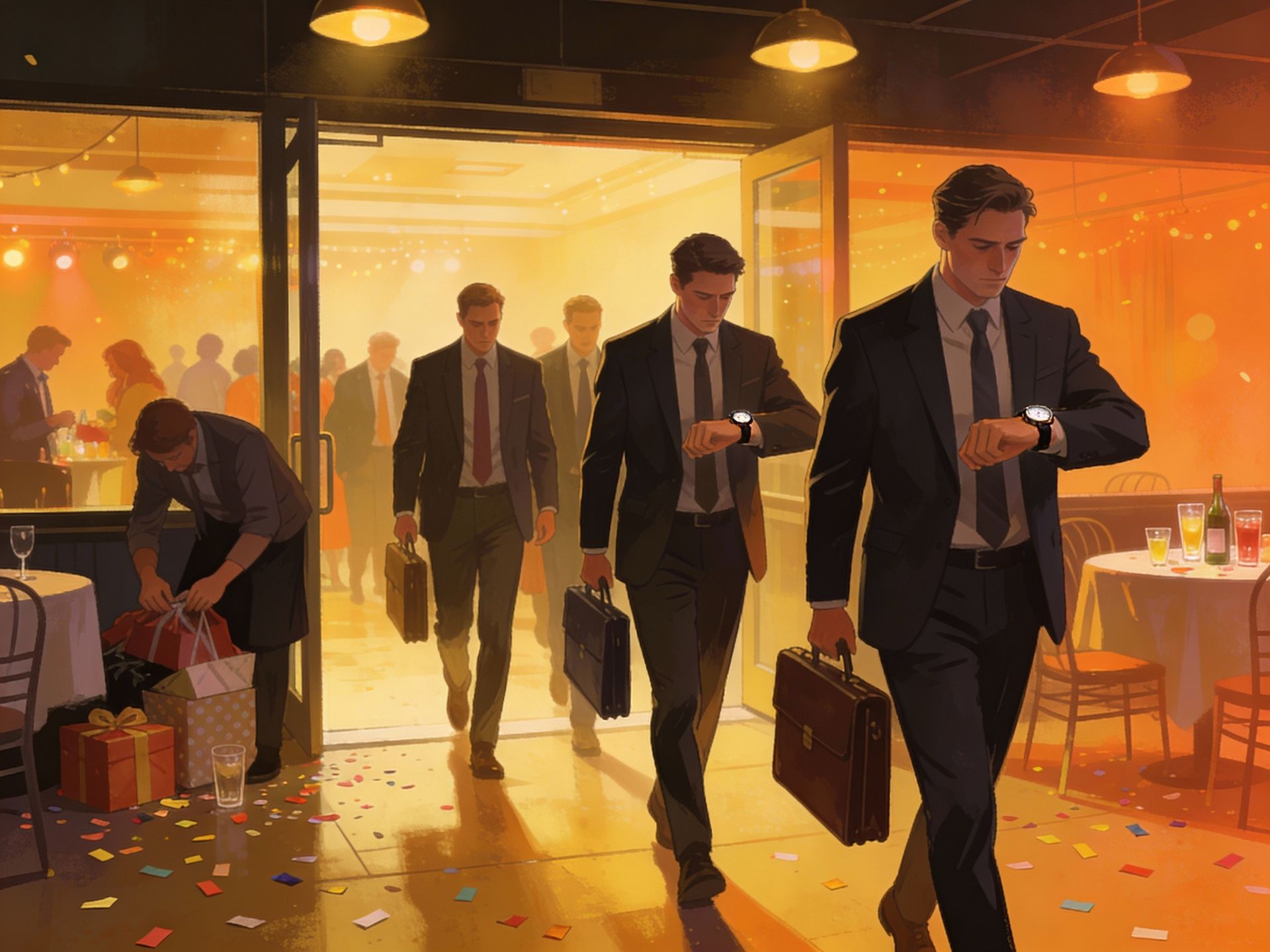
Apple was the original “you’ll get fired if you don’t own it” trade, and almost nobody on Wall Street believed in it until the S‑curve was half over. Nvidia is running the same psychological playbook in a different technological super‑cycle, and the data say the Street, once again, is showing up late to its own party.
Steve Jobs literally got fired from the company he founded, spent a decade in the wilderness (NeXT, Pixar), and then came back to a near‑terminal Apple that analysts had basically written off as a 90s hardware relic.
• In his Stanford speech, Jobs said “getting fired from Apple was the best thing that could have ever happened to me,” framing the exile as the reset that let him bet big later.
• When he came back, Apple was not priced or covered like a future empire; it was a turnaround footnote in tech, with Wall Street focused on Dell, Microsoft, and the “real” PC winners.
Then came the boom‑or‑bust moment: the iPhone.
• Launching a high‑end, vertically controlled smartphone was seen as arrogant and risky in a market dominated by Nokia, BlackBerry, Motorola; most commentary was about why it wouldn’t scale.
• Yet that single bet turned Apple from “might not make it” into one of the most profitable companies in history and rewired entire industries from carriers to music to mobile computing.
The point is that the best investment of the next 20 years did not look like the best investment of the next 20 years when it mattered most.
Wall Street did not chase Apple at the bottom; it endorsed Apple after the risk was gone and the numbers were already obscene.
• SPIVA data show that in any given year roughly 60–65% of active large‑cap funds underperform the S&P 500.
• Over longer windows (10–15 years), more than 90% of active U.S. large‑cap managers lag their benchmarks, which is what you get when your process is systematic career risk management, not truth seeking.
Once Apple’s growth, margins, and ecosystem dominance were undeniable, it morphed into a benchmark hugger’s security blanket.
• The industry cliché “you can’t get fired for owning Apple” is just shorthand for: as long as you hug the winners late, you can underperform quietly with everyone else and still keep your job.
• Research on institutional herding shows funds crowd aggressively into the same large‑cap growth names, especially on the buy side after upgrades, exactly when the risk‑reward skew is already worse.
By the time Apple was a “must own,” the real wealth creation phase was already years old. Wall Street’s conviction arrived last, after mark‑to‑model had been replaced by mark‑to-career.
Now replace “smartphone computing” with “accelerated computing + AI infrastructure” and Apple with Nvidia.
• Herding papers show that investors particularly crowd into large‑cap growth stocks after strong runs, not before, and herding has intensified around precisely these types of names in recent years.
• Analysts and institutions display sentiment‑driven herding, especially in stocks that are “hard to value” and highly sensitive to narrative—exactly the category Nvidia lives in.
The skepticism pattern rhymes with early iPhone Apple:
• Endless models arguing peak demand, “one‑product risk,” or that AI capex is cyclical, not structural—while actual reported numbers keep forcing estimate revisions upward.
• Studies of analyst behavior show persistent underreaction to new information and anchoring on old regimes, which is why earnings revisions in transformational winners are often a slow, grinding capitulation rather than a sharp re‑rating at the start.
The hate always sounds “fundamental,” but is usually just the discomfort of people whose spreadsheet can’t stretch fast enough to price a regime change.
Economic and tech‑driven super‑cycles have a rough three‑act structure. The dates and toys change; the human behavior does not.
Economic and tech‑driven super‑cycles have a rough three‑act structure. The dates and toys change; the human behavior does not.
**Early phase – disbelief with **
• You get a genuine innovation (PCs, the internet, smartphones, AI compute) that creates new markets, but macro data still look “normal” and consensus treats it as a niche.
• Market researchers document underreaction and dispersed beliefs; few are willing to wildly extrapolate because it’s career suicide to be early and wrong, but totally safe to be late and consensus..
Middle phase – grudging acceptance:
• The impact shows up in GDP components, capex, productivity, and corporate earnings; a handful of names start dominating index returns.
• This is when large‑cap growth becomes the herd destination: funds crowd into the winners not because they “believe,” but because not owning them starts to guarantee underperformance versus the benchmark.
Late phase – narrative overshoot:
• The innovation label gets slapped on everything: dot‑com in 1999, “New Economy,” housing/credit in 2006, “AI everything” in the current cycle.
• Retail and late‑cycle institutions chase the theme at high valuations; academic work on return co‑movement and attention shows return correlations spike as people stop analyzing and just buy the story.
The irony is that the beginning of the super‑cycle is when the risk is existential, but the reward is gigantic; the end is when the risk is hidden, crowded, and subtle, but everyone feels safest.
Late adopters and why Wall Street shows up last which Behavioral finance has basically turned “Wall Street shows up last” into a peer‑reviewed fact.
• Analyst and investor studies document herding, overconfidence, status quo bias, and an asymmetric focus on downside (career risk) over upside (alpha).
• Mutual fund research finds herding is strongest among growth funds and in small and high‑uncertainty names, but large‑cap herding spikes when narratives get hot.
Traits of the late adapters:
• Their process is benchmark‑anchored; missing the S&P by 200 bps matters more than missing the next Apple entirely. SPIVA’s long‑horizon data—90%+ of active large‑cap funds underperform over 15 years—shows how that mindset compounds into chronic failure.
• They move in packs around rating changes: studies show institutional “sell herding” is pronounced after downgrades and “buy herding” after upgrades, meaning they systematically buy high and sell low in the name of risk control.
This is the crowd “who wouldn’t recognize a great company if it landed on their butt crack” because greatness is defined ex post by index weight, not ex ante by insight.
Their edge is explaining yesterday in 50 pages of slides.
Meanwhile, the old financial religion keeps everyone trading transitions instead of owning compounding:
• Short‑termism and overtrading are chronic; the literature ties this to overconfidence and attribution bias, where managers credit skill for wins and blame luck for losses, reinforcing bad behavior.
• The end result is a profession that worships volatility management while quietly failing to beat a basic S&P 500 index fund year after year.
Apple exposed that failure in the 2000s; Nvidia is exposing it again now. The question for you to answer is simple: are you going to think like the benchmark huggers who only believe when it’s career safe, or like the small minority that actually gets paid to be early, lonely, and directionally right?
WHEN INVESTING BECOMES A LIFESTYLE YOU WEAR IT!
NEW MERCH ALERT - BILL GATES BLACK - Limited Quantities - Grab Yours Today! CLICK HERE

Bill Gates Black…
Someone’s Nightmare Is Someone Else’s Dream…
There is a moment in almost every founder’s journey when the noise stops.
No more clapping, no more “you got this,” no more hype. Just the sound of your own breathing and one brutal question beating in your head: “Did I just ruin my life for a bad idea?”
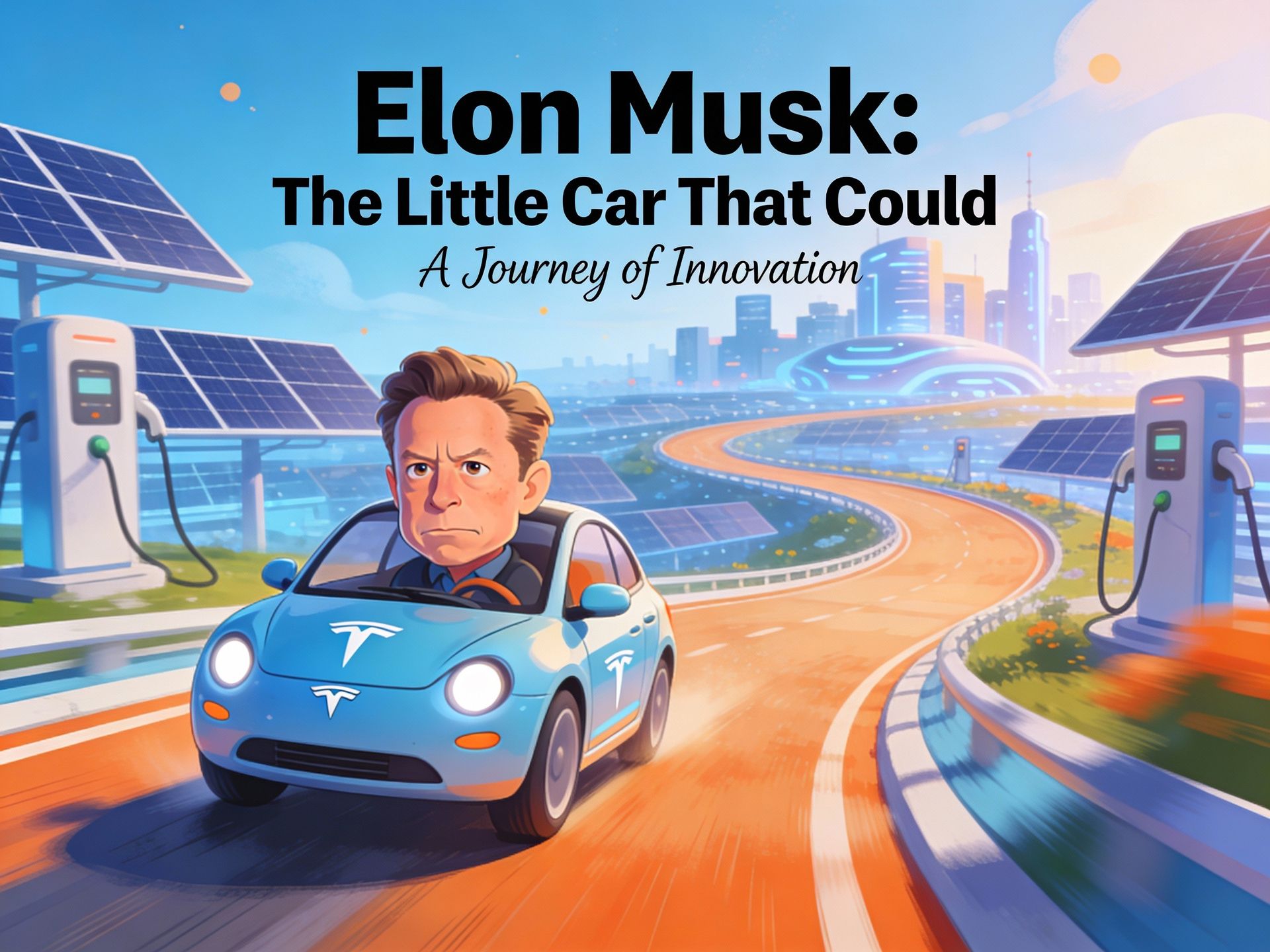
Elon Musk knows that moment better than most.
Not the meme version, not the billionaire caricature—the version of him in 2008 who was borrowing money from friends to pay rent while running two companies that were both circling the drain. Tesla wasn’t a stock symbol; it was a punchline.
When Tesla Was a Terrible Idea, in the mid‑2000s, the “plan” was simple and insane: build an electric sports car that didn’t feel like a golf cart. Tesla’s first product, the Roadster, was supposed to be the proof that electric cars could be fast, sexy, and worth caring about. Instead, it became a masterclass in pain.
The platform had to be reworked, the engineering was harder than anyone expected, costs exploded, and delays stacked up. Cars broke. Prototypes failed.
The bill for fixing early mistakes kept growing. Every problem had a price tag attached, and those tags started to look like a death sentence.
By 2008, the global financial system was melting.
Credit was drying up. Major automakers were fighting for survival. And in the middle of that storm was a tiny company trying to convince the world that batteries and software could beat gasoline and a century of incumbents.
Tesla had almost no cash left. Payroll was days away. Suppliers were threatening to walk. Customers who had put deposits down were getting nervous. Most rational people would’ve shut it down, preserved what was left, and gone home. Musk did the opposite.
Elon Musk had already poured essentially his entire PayPal fortune into Tesla and SpaceX. When the markets froze, he didn’t have a safety net; he had a choice: pick one company to save and let the other die or do something that looked suicidal on paper and try to save both.
He chose the crazy option.
He split his remaining money and doubled down on both companies, even while using credit cards and loans from friends just to keep going in his personal life. Tesla needed roughly $40 million in emergency funding to avoid collapse.
That round didn’t close weeks in advance with champagne and smiles. It closed on Christmas Eve 2008—in the last possible hours—after a tense, desperate scramble that could easily have gone the other way.
On that call, when investors finally agreed and the wire was secured, people in the room recall Musk breaking down in tears. Not billionaire-on-a-yacht tears—exhaustion, fear, relief, and the raw realization that everything he’d been building had been hanging by a single fraying thread.
Tesla didn’t “win” that day. It survived.
And surviving meant one thing: one more day to fight.
Years later, on national television, Musk would reveal that he has Asperger’s syndrome, a form of autism that affects social skills, communication, and how emotions are expressed. He joked that it explains why he sometimes says or posts strange things, adding that this is just how his brain works.
What looks like social awkwardness from the outside can feel like a disconnect from the world on the inside. Reading rooms, navigating small talk, smoothing edges—these are not his strengths. But hyperfocus, pattern recognition, obsession with solving hard problems? That’s where a brain wired differently becomes a weapon.
When people said, “This will never work,” he didn’t just disagree emotionally; he disagreed logically. Physics said batteries could work. Software said cars could improve over time. Data said the incumbents were trapped in their own inertia.
So he ignored the noise and followed the numbers, even as his personal life and bank account were cracking under the pressure.
For founders who feel “different,” this is the quiet subtext of his story: the thing that makes you socially off‑beat may be the same thing that makes you relentless enough to build what others can’t.
Tesla would go on to launch the Model S, Model 3, and an entire shift in how the world thinks about cars. The same company that almost died over a $40 million lifeline became, for a time, the most valuable automaker on the planet.
The same guy who was mocked for chasing electric cars and rockets now gets treated like a walking economic indicator. None of that was visible in 2008 when he was a few signatures away from disaster.
This isn’t a story about destiny. It’s a story about staying in the game just long enough for your work to catch up to your vision.
If you’re the small founder right now:
• Sitting at a cheap desk, staring at a burn‑rate that doesn’t care how hard you’re trying.
• Getting told by “smart” people that you’re naive.
• Refreshing your inbox for an investor who still hasn’t replied.
Remember this: one of the wealthiest, most influential builders alive once sat there, broke, exhausted, and terrified that he’d dragged everyone he cared about into a doomed dream.
The difference is, he kept showing up. He kept asking, “What can I fix today? What can I learn, who can I call, what can I ship?” when his brain was telling him to run.
You do not need to know everything.
You do not need to be perfect.
You just need to be stubborn enough to outlast your own doubt.
There will be nights where your chest is tight and your eyes burn and you wonder if any of this is worth it. There will be days where the silence from customers, investors, and friends is louder than any criticism.
That is not the universe telling you to quit. That is the test almost every meaningful company has had to pass.
Musk’s story is not permission to worship a billionaire. It is a reminder that behind every “overnight success” is a human being who almost quit, almost broke, almost lost it all, and chose—one more time—to get up the next morning and fight.
If you’re building something right now and feeling small, scared, or alone, hear this:
You might be standing in your own 2008.
Your Christmas‑Eve‑wire moment may not be here yet.
Keep going.
You’re not just building a business.
You’re building your last name.
WHEN INVESTING BECOMES A LIFESTYLE YOU WEAR IT!
NEW MERCH ALERT - BUY THE DIP NAVY - Limited Quantities - Grab Yours Today! CLICK HERE

BUY THE DIP NAVY…
Thank you for reading, we appreciate your feedback—sharing is caring.
Reply